
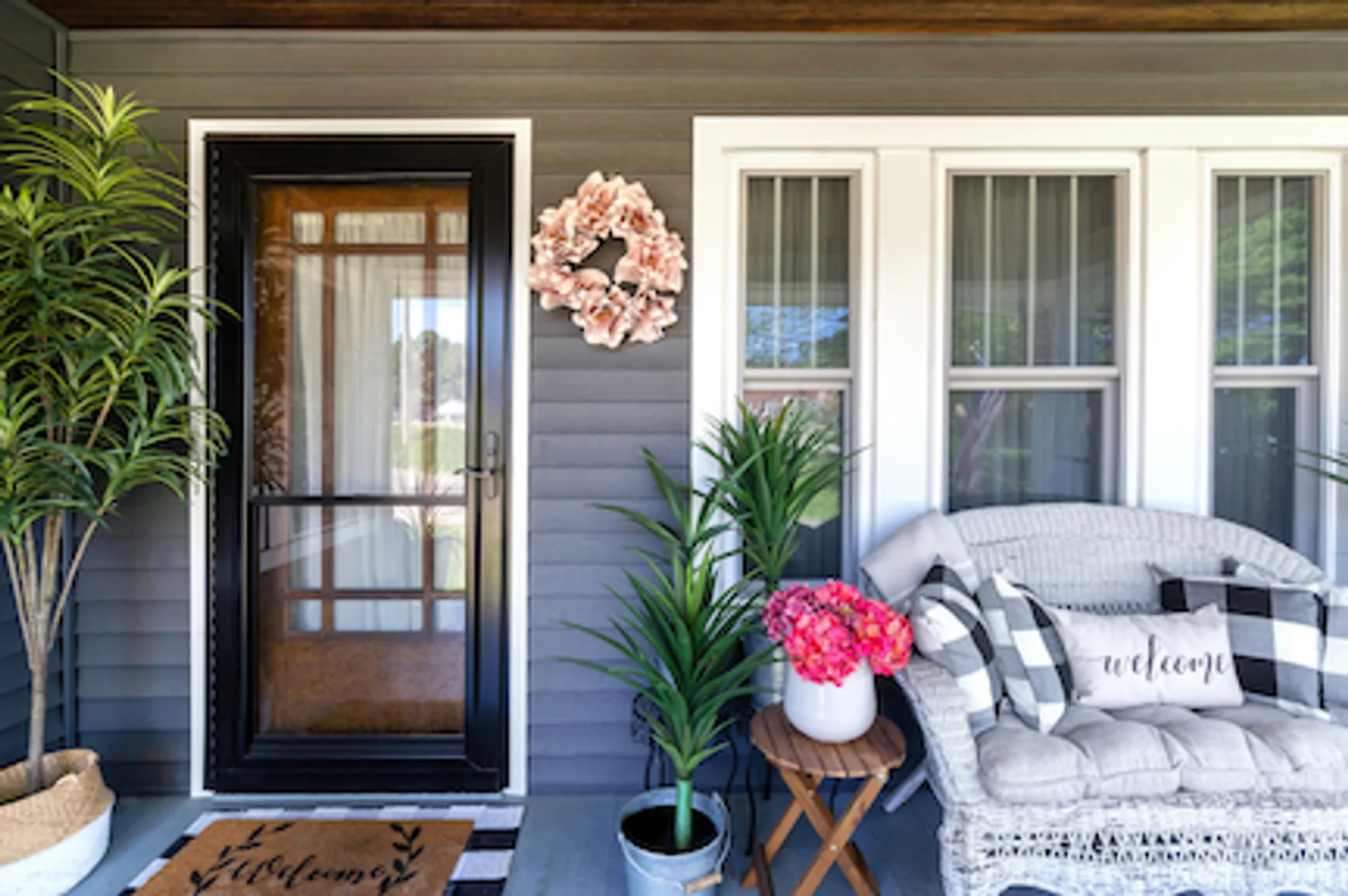
Best for: Extra weather protection and ventilation over an entry door
A second door mounted outside your entry door. It’s the least expensive thing you can add to an entry opening and it does three genuinely useful jobs.
What a storm door actually does
It protects the door behind it. This is the one people underrate. A storm door takes the sun, the wind-driven rain, and the temperature swing that would otherwise hit your entry door directly. On a south- or west-facing entry, that’s the difference between a finish that lasts and one that chalks and fades in a few seasons — and finish coverage on an entry door is one of the shorter warranty terms you have.
It gives you ventilation with the door closed. Full-view models with retractable screens let you open the main door and get airflow through the entry without leaving the house open. In spring and fall in our markets, that’s most of the season.
It adds a modest efficiency gain by creating a buffer air space at the entry.
Choosing one
- Full view — maximum glass, best for showing off an entry door you just paid for. Retractable screen options give you ventilation without a permanent screen in the sightline.
- Ventilating — a fixed screen panel with glass that slides, for people who want airflow most of the time and don’t want to swap panels.
- Self-storing — glass and screen both live in the door; you slide rather than store panels in a garage.
One caution worth stating plainly: a full-view storm door over a dark-colored entry door in direct sun can trap significant heat between the two, and on some door types that heat can damage the finish or the slab. If your entry faces south or west and the door is dark, ask us about it at the measure — sometimes a ventilating model is the better call. This is exactly the kind of thing that shouldn’t be a surprise later.
What’s different about installing a storm door
Storm doors have a reputation as a simple install, and that reputation is why so many are installed badly.
The mounting has to be square to the existing frame, not to the opening. A storm door hangs off the entry door’s brickmould or trim, and if that trim isn’t square — common on older homes — a storm door mounted flush to it binds or leaves a gap.
The closer needs proper backing. A closer bracket screwed into hollow trim will pull out, usually the first time the door catches wind. It needs to hit solid material.
Wind is the enemy. A storm door catching a gust with no wind chain and no properly-adjusted closer will over-swing and tear its own hinge rail out. Both get set correctly at install; neither takes long.
What we install
ProVia storm doors in Spectrum™, Superview™, Deluxe™, Decorator™ and DuraGuard™ — full-view, ventilating, and self-storing, with retractable screen options and colors that coordinate with your entry door.