
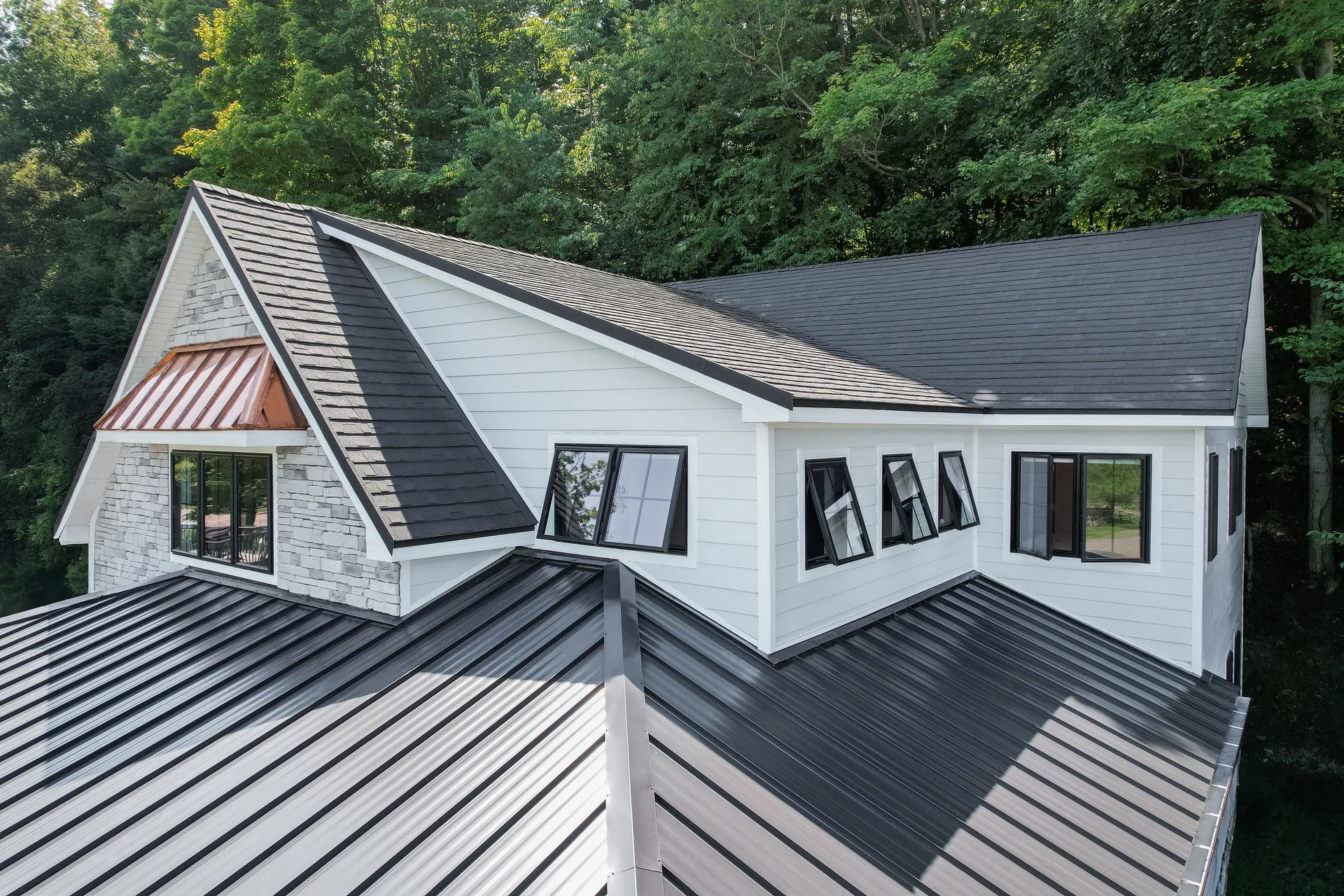
Best for: Hard-to-reach spots (over sinks); best airflow/ventilation
Hinged at the side, cranked open outward like a door. The whole opening clears, which makes casement the best-ventilating window style there is — and the crank means you don’t have to reach the window to operate it.
When casement is the right choice
Over a sink, counter, or anything you’d have to lean across. This is the single best argument for casement and the reason it’s so common in kitchens. A crank at the bottom of the frame beats reaching over eighteen inches of countertop to lift a sash.
When you want airflow. A casement opens to essentially 100% of its area, versus about 50% for a double-hung, and because the open sash sits perpendicular to the wall it can actually scoop breeze into the room. In a bedroom you sleep in with the windows open, the difference is obvious.
When you want fewer sightlines. No meeting rail across the middle of the glass.
It’s the wrong choice where the sash would open into something — a walkway, a deck, a patio you use. It swings out, and it swings out far.
What’s different about installing a casement
Casement is less forgiving of an out-of-square opening than any other style, and it’s the one where a rushed install shows up soonest.
A double-hung sash slides in a channel and tolerates a small amount of frame irregularity. A casement sash swings on hinges and has to meet its weatherstrip along the entire perimeter in a single motion. If the frame is even slightly racked, the sash contacts on one side before the other — you feel it as a crank that takes more effort near the end of its travel, and it shows up later as a draft along one edge and premature hardware wear.
The hardware is also doing more work here. Operators and multipoint locks on a casement carry load a double-hung’s simply doesn’t, which is why coastal installations get a reduced hardware warranty from ProVia and inland ones don’t.
Setting a casement true isn’t harder than any other window. It just leaves no room to be slightly off. We check diagonals after setting, shim at every fastening point, and cycle the operator through full travel before signing the job off.
What we install
ProVia casement across the line, with folding nesting handles that clear blinds and shades, and stainless hardware options. Frequently specified alongside picture windows in a combination unit — casements flanking a fixed center pane give you the view and the ventilation.